
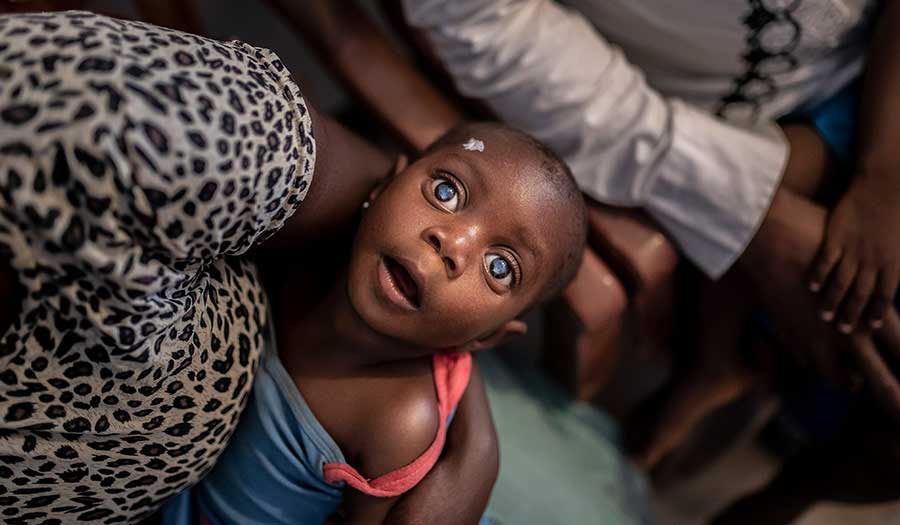
 ANDRAS D. HAJDU/OWW AND FOUNDATION OF DOCTOR RICHARD FOR CONGOLESE PATIENTS
Article
Humanitarian organizations and charitable groups are working to eradicate eye disease. Their efforts point to an even greater purpose.
Learn the why behind the headlines.
Subscribe to the Real Truth for FREE news and analysis.
Subscribe NowPeople who can see clearly, even with the help of glasses or contacts, sometimes take it for granted. Yet a look at conditions in another part of the world provides a fresh perspective.
Cataracts are the chief cause of blindness on the planet. Groups such as the Cure Blindness Project—with its pioneering work in eliminating cataract disease in Nepal, Ethiopia, Myanmar and other developing nations—have opened the eyes of the masses, both literally and figuratively.
A former leper colony in Ethiopia was the site for one of the organization’s cataract surgery campaigns.
Dr. Matt Oliva, one of four surgeons on the team, described the situation to Vice News: “Blindness in Ethiopia is a death sentence, it’s a social problem, it’s a human suffering problem, and it’s an economic problem.” Another ophthalmologist on the team added, “In a society where you don’t have social security or things like that, these people are dependent on their family to whom they become a burden.”
Those suffering from cataracts, which is a clouding of the eye lens, in developing nations discover that life as they knew it is essentially over. One woman, blind from the condition, said: “My little children look after me, I can’t even visit my friends. I just stay at home” (ibid.).
An elderly man with milky white eyes due to the disease painted a similarly grim picture: “I’m a farmer and I used to grow khat and sorghum. But now I can’t do it anymore. So, I have become a beggar and now I beg every day.”
The Cure Blindness Project’s mission is seeking to change it all by eradicating as much unnecessary blindness as possible. According to its website, cureblindness.org, since 1995 it and partners have screened and treated over 19 million people, provided almost 2 million sight-restoring surgeries, and trained thousands of doctors to do the same.
Many in Ethiopia are blind due to untreated cataracts, which can be cured with a 10-minute surgery (the materials cost less than $25). In November 2024, the Cure Blindness Project set a record of sight-restoring surgeries in Ethiopia. Over several trips during the 30-day period, over 12,000 people had their sight restored through cataract surgery.
Watching young and old in jubilation as their vision is restored changes you. One by one, as doctors remove the surgical bandages a mere 24 hours following the procedure, patients scream, squeal and dance as their brains experience a sense that many patients had long given up on—sight.
The pure happiness on display, genuine embraces and overwhelming emotions are heartwarming. They demonstrate, in a most graphic way, the one-of-a-kind joy of being made whole.
One Man’s Vision
The Cure Blindness Project was co-founded by Dr. Sanduk Ruit, a 65-year-old ophthalmologist from Nepal. It was previously called the Himalayan Cataract Project.
Following his studies in India, the Netherlands and the United States, Dr. Ruit pioneered a simple, stitch-free surgical technique to cure cataracts. The procedure was so effective it began to be called a Ruitectomy.
Instead of relying heavily on machines, Dr. Ruit’s manual surgical technique involves making a small incision on the surface of the eye just below the iris. Guided by a highly magnified image, the surgeon inserts a small tool resembling tweezers into the incision and pulls out the damaged lens. The doctor then replaces the old lens with an artificial one by pushing it into the same opening.
Though slicing into the surface of the eye and poking and prodding around may sound gory, it remarkably is not. The procedure requires no stitches and there is little to no blood involved.
The surgery is completed within 10 minutes, and the doctors apply thick eye patches with bandages in the hope that the patient’s vision will be restored following a day of recovery.
Family and friends witnessing the removal of the bandages are usually just as excited in anticipation of the patient once again recognizing them, sometimes after years of being unable to. When the patches are removed, it takes a couple of seconds for the brain of the former cataract sufferer to adjust to what is being seen. Moments later there is an unbelievable smile, demonstrating that the surgery was a success. Ninety percent of patients will see well enough to pass a U.S. driver’s license test.
The ease and manual nature of the surgery, the assembly line approach, and Dr. Ruit’s innovative $3-per artificial lens is how $25 of supplies and 10 minutes can help a person see again.
Greater Impact
Organizations besides the Cure Blindness Project are also taking on the task of doing all they can to cure blindness. The International Agency for the Prevention of Blindness lists other partners such as the World Council of Optometry, Sightsavers, and VisionSpring. The primary focus of all these groups is on the blind in the developing world.
Their work was initially shunned in ophthalmology circles. Many took issue with the unconventional research and work in environments considered squalid by Western standards. Yet groups stuck to the belief that excellent care could be delivered to the poor.
Not only do the majority of these programs waive surgery fees for those unable to pay, they also utilize mobile eye camps to take their services directly to people in hard-to-reach places. For instance, those doing work in and around the Himalayan region transport their equipment by vehicle as far as possible, then complete the journey by foot through mountainous terrain.
Once these mobile care teams get to a village, they immediately begin the work of transforming any available space into a sterile location for surgery. The location must be accessible and able to handle a large volume of patients who travel from miles around seeking to be cured. In a matter of hours, the team converts a dusty room into an operating area nearly equivalent to a clinic in the developed world.
While the work of all these organizations is admirable and they have made a positive impact, millions are still suffering from cataracts and awaiting care.
This reality drives efforts to pass along blindness prevention knowledge to other doctors. The Cure Blindness Project alone has helped train more than 20,100 eye-care personnel from 43 countries, of which over 640 are doctors. They have built hospitals in Ghana, Ethiopia, India and China. They have also worked in North Korea, Cambodia, Bangladesh and Vietnam.
These individuals are some of the many in the blindness prevention community hoping to bring the joy of sight to hundreds, thousands and eventually millions.
Miracle of Sight
Helping people see again is inspiring. In our world dominated by misery and despair, it is encouraging to witness uplifting accounts of people having their vision restored.
On the cureblindness.org website is an article titled “The Miracle of Cataract Surgery: Ten Minutes That Change Everything” that explains some of the impact of their work. The work of the Cure Blindness Project does feel miraculous. Though cataract surgery may not fit the exact definition of a miracle, it is nevertheless hard to explain it any other way.
Miracles grab and hold our attention.
Jesus Christ knew this very fact. In the New Testament, He even explained it to a high-ranking official who, despite his status, was unable to find a cure to his son’s terminal illness. He was left with no other option but to seek Christ and beg Him to heal his dying son (John 4:46-47). Christ’s response alluded to His important purpose for healing people: “Except you see signs and wonders, you will not believe” (vs. 48). He then healed the official’s son. This irrefutable sign made the man and his entire household believers in Jesus and His ministry (vs. 53).
The Greek word translated “signs” means an indication, especially supernatural (Strong’s Exhaustive Concordance). This term is many times translated “miracle.” A true miracle is an event inexplicable by natural or scientific laws. It is solely of divine origin.
Jesus’ first official miracle was changing water to wine at a wedding, which also helped people to believe in His divine authority (John 2:11). This act caught the attention of those of a certain status. However, Christ’s most numerous and impactful miracles were those through which He brought or restored health to others, many of them poor. John 6:2 records, “A great multitude followed Him, because they saw His miracles which He did on them that were diseased.” Christ’s divine healing of the masses could not be explained away by nature or science.
Blindness was just one of the myriad diseases Jesus addressed: “And great multitudes came unto Him, having with them those that were lame, blind, dumb, maimed, and many others, and cast them down at Jesus’ feet; and He healed them: insomuch that the multitude wondered, when they saw the dumb to speak, the maimed to be whole, the lame to walk, and the blind to see: and they glorified the God of Israel” (Matt. 15:30-31).
People brought their loved ones with the hopes of them being made whole. Many who had all but given up hope had their lives forever changed. When the healing came, it brought tremendous joy and exuberance (Luke 17:15-16).
Yet the question remains: What did the divine healings signal or indicate? Yes, people were made to feel better, but what did it all point to? What was the purpose of Christ’s ministry?
Read His own words: “Then Jesus answering said unto them, Go your way, and tell John [the Baptist] what things you have seen and heard; how that the blind see, the lame walk, the lepers are cleansed, the deaf hear, the dead are raised, to the poor the gospel is preached” (Luke 7:22).
Christ wrapped His greater message—that of the gospel—in the healing of the sick. Helping people see, hear, walk and in some cases live again got their attention and the attention of witnesses.
Making people whole became the catalyst or means by which Christ spread the gospel. The word gospel appears in the Bible over 100 times. It is an Old English word meaning “god spell” or good news. The word kingdom is also an Old English term that means “government.”
Therefore, it is proper to say that Jesus Christ came as a divine newscaster bringing the gospel or good news of the soon-coming Kingdom of God (Mark 1:14). Do not be fooled or misled by those who claim the gospel is about the person of Christ or various misnomers such as the gospel of salvation, gospel of grace, gospel of faith or a social gospel. These are unbiblical!
Jesus Christ, who plays a central role in Christianity and salvation, brought the only true gospel the Bible speaks of—the good news of God’s Kingdom coming to Earth. He also tied it to the joy and elation of being healed.
The government of God coming to Earth is God’s overarching message to mankind. Under this divine rulership, all of mankind will have access to its Creator and will learn to live His way of life. One of the benefits of this way is good health. This is a major reason Christ focused on this during His 3.5-year ministry.
Healing the sick on the spot helped people recognize Jesus’ credibility and believe His seemingly unbelievable statements. Making them whole also became the chief reason to believe He was the Son of God who brought a message to mankind (John 7:31).
The happiness that comes with being healed made Christ’s words live, just as they do today.
Coming Good News
Good news is coming. God promised it would. He said plainly that we should repent (meaning change) and believe the gospel (Mark 1:15). The reader is therefore left with the same question presented to the throngs that followed the living Jesus Christ. Will you believe?
The Real Truth magazine and The Restored Church of God are committed to obeying Christ’s command to “preach the gospel to the poor” (Luke 4:18).
The articles we present bring clear understanding to the problems of today’s world. They reveal the coming solutions to the world’s evils and ills.
In God’s Kingdom, people will be healed and made whole. They will find permanent solutions to what ails them, physically, emotionally and spiritually. They will also experience the exuberance that comes along with it.
For more on what the gospel is and is not, according to the Bible, order our free booklet Which Is the True Gospel? It will give you a much clearer understanding of the central message Jesus delivered, and a picture of the awesome environment in which all will soon be made whole.
More on Related Topics:
- Afghan Hunger Crisis Deepens as Aid Funding Falls Short, UN Says
- Israel’s Longest War Is Leaving a Trail of Traumatized Soldiers, With Suicides Also on the Rise
- Maintaining Your Health as You Grow Older
- ‘Nightmare Bacteria’ Cases Are Increasing in the U.S.
- Americans Get More Than Half Their Calories from Ultra-Processed Foods, CDC Report Says
Latest News
-
December 17, 2025
- Explainer: What’s Next for the Gaza Ceasefire, and Will the Truce Last? December 16, 2025
- Afghan Hunger Crisis Deepens as Aid Funding Falls Short, UN Says December 15, 2025
- ‘It Was Dead People Everywhere’: Inside Australia’s Hanukkah Massacre December 11, 2025
- Bulgaria’s Government Resigns After Mass Protests
- ‘It’s Not Safe to Live Here.’ Colombia Is Deadliest Country for Environmental Defenders December 10, 2025
- A Year After Assad’s Fall, Families of Missing Detainees Languish Without Answers December 9, 2025
- Australia’s Social Media Ban for Children Takes Effect in World First
- Cambodia Vows Fierce Fight Against Thailand in Escalating Border Conflict December 8, 2025
- ‘Everything Destroyed’ as Indonesia’s Aceh Grapples with Disease After Floods December 3, 2025
- Explainer: Why Is Fate of Donetsk Region a Sticking Point in Talks on Ending War in Ukraine? November 26, 2025
- Sudan’s Top General Rejects U.S.-Led Ceasefire Proposal, Calling It ‘The Worst Yet’
- Gaza Truce Progress Slow as Israeli-Hamas Violence Persists
- More People Are Addicted to Marijuana, But Fewer of Them Are Seeking Help, Experts Say November 21, 2025
- What Is in the U.S. Peace Plan for Ending the War in Ukraine?
- Explainer: What’s Behind Nigeria’s Latest School Abductions and Church Attack?
- A Drying-Up Rio Grande Basin Threatens Water Security on Both Sides of the Border November 19, 2025
- The Education Department Is Dismantling. Here’s What That Means November 14, 2025
- Women in Darfur Report Rape, Lost Children amid Sudan Violence, UN Says
- 10 Years After the Bataclan Massacre, Paris Is Still Scarred by That Night of Terror November 13, 2025
- Israel’s Longest War Is Leaving a Trail of Traumatized Soldiers, With Suicides Also on the Rise
